
Training for caregivers of children with developmental disabilities, including autism
More than 50 million children have a developmental disability such as an intellectual disability, autism, or a speech disorder. Without appropriate support, these conditions often limit these children’s ability to benefit from the educational and social opportunities that others take for granted. They are often denied access to school and are more likely to experience violence, neglect, and other forms of abuse. Their caregivers are often stigmatised, isolated and impoverished. Despite this, most children with developmental disabilities and their families do not have access to the care and support they need.
For caregivers of children with developmental disabilities, parenting programmes can be particularly beneficial in increasing their confidence and parenting skills. They can also lead to improved well-being of both caregivers and children.
In view of this, WHO, along with international partners, has developed a five-part package on Caregivers Skills Training for families of children with developmental delays or disabilities (CST) (the 5 CST documents are available below).
Caregiver skills training for families of children with developmental delays or disabilities
This document is part of a package that provides guidance on caregiver skills training for families of children with developmental delays or disabilities....
Caregiver skills training for families of children with developmental delays or disabilities - Introduction
This is the first part of a five-part package that provides guidance on caregiver skills training for families of children aged 2–9 years with developmental...
Caregiver skills training for families of children with developmental delays or disabilities - Adaptation...
This adaptation and implementation guide is part of a five-part Caregiver skills training for families of children with developmental delays or disabilities...
Caregiver skills training for families of children with developmental delays or disabilities - Facilitators’...
This facilitators’ guide is part of a five-part Caregiver skills training for families of children with developmental delays or disabilities (CST)...
Caregiver skills training for families of children with developmental delays or disabilities - Participants’...
This participants’ guide is part of a five-part Caregiver skills training for families of children with developmental delays or disabilities (CST)...
Caregiver skills training for families of children with developmental delays or disabilities - Home...
This guide is part of a five-part Caregiver skills training for families of children with developmental delays or disabilities (CST) package providing...
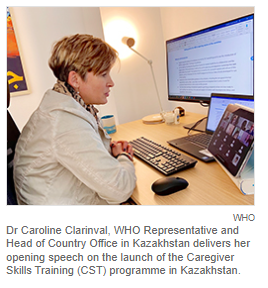
The CST consists of nine group sessions and three individual home visits, and focuses on training the caregiver on how to use everyday play and home activities and routines as opportunities for enhanced interaction and participation, development and learning. The sessions specifically address communication, engagement, daily living skills, challenging behaviour and caregiver coping strategies.
An online version of the training, targeted at caregivers, is available.
To register for the online training:
Register on WHO Academy: Click here
To start the course: Open the course then click on the button: Enroll
Feature stories

Fact sheets
Publications
Mental Health Gap Action Programme (mhGAP) guideline for mental, neurological and substance use disorders
The mhGAP guideline supports countries to strengthen capacity to deal with the growing burden of mental, neurological and substance use (MNS) conditions...
Global report on children with developmental disabilities
Developmental disabilities are common. Yet, children with developmental disabilities have been neglected in health systems planning and policy provisions...
WHO guidelines on parenting interventions to prevent maltreatment and enhance parent–child relationships...
This guideline provides evidence-based recommendations on parenting interventions for parents and caregivers of children aged 0–17 years that are...
Health topics
Related links